Percentages are everywhere — sale discounts, interest rates, tax, investment returns, nutrition labels, and statistics. Yet many people find percentage calculations confusing, especially when they're applied in different ways. This guide breaks down every type of percentage calculation you'll encounter in everyday life, with simple examples throughout.
What does "percent" actually mean?
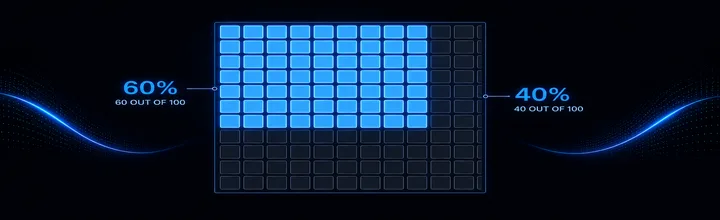
The word "percent" comes from the Latin "per centum" — meaning "out of one hundred." So 25% simply means 25 out of every 100, or 0.25 as a decimal. That's the foundation of every percentage calculation.
Converting between percentages and decimals is simple: divide by 100 to go from percentage to decimal, and multiply by 100 to go the other way.
- 25% = 0.25
- 7.5% = 0.075
- 150% = 1.5
- 0.5% = 0.005
The four most common percentage calculations
1. Finding a percentage of a number
"What is 20% of $85?"
A restaurant bill is $85 and you want to leave a 20% tip. The tip is $17, making the total $102.
2. Finding what percentage one number is of another
"30 is what percent of 200?"
You scored 62 out of 80 on a test. Your percentage score: 62 ÷ 80 × 100 = 77.5%
3. Percentage change
"A product went from $40 to $52. What's the percentage increase?"
Your salary went from $48,000 to $52,000. The increase: (52,000 − 48,000) ÷ 48,000 × 100 = 8.3% raise
4. Adding or subtracting a percentage
"A $120 item is on sale for 35% off. What's the price?"
Adding 15% tax to a $200 product: $200 × 1.15 = $230
Common percentage mistakes to avoid
Percentage points vs percentages
These are not the same. If an interest rate rises from 3% to 4%, it has increased by 1 percentage point — but it has increased by 33% (because 1/3 is roughly 33%). Politicians and advertisers often conflate these deliberately, so it's worth knowing the difference.
Percentage increases don't reverse with the same percentage decrease
If a stock rises 50% and then falls 50%, you don't break even. A $100 investment rising 50% becomes $150. That $150 falling 50% becomes $75 — a net loss of 25%. This asymmetry trips people up in investment contexts regularly.
"Up to X% off" in sales
When a sale advertises "up to 50% off," only a small number of items are actually discounted by 50%. Most will be discounted far less. The "up to" is doing a lot of work in that sentence.
Percentages in finance
Understanding percentages is particularly important in financial contexts:
- Interest rates — a 1% difference on a large loan or mortgage adds up to thousands over the loan term
- Investment returns — compounding turns small percentage gains into large sums over time
- Inflation — a 5% annual inflation rate means your money loses purchasing power at that rate each year
- Savings rates — even a small increase in the percentage you save from each paycheck has a dramatic long-term effect
Need to calculate a percentage instantly? Our free percentage calculator handles all four types in seconds.
Use the percentage calculator →